
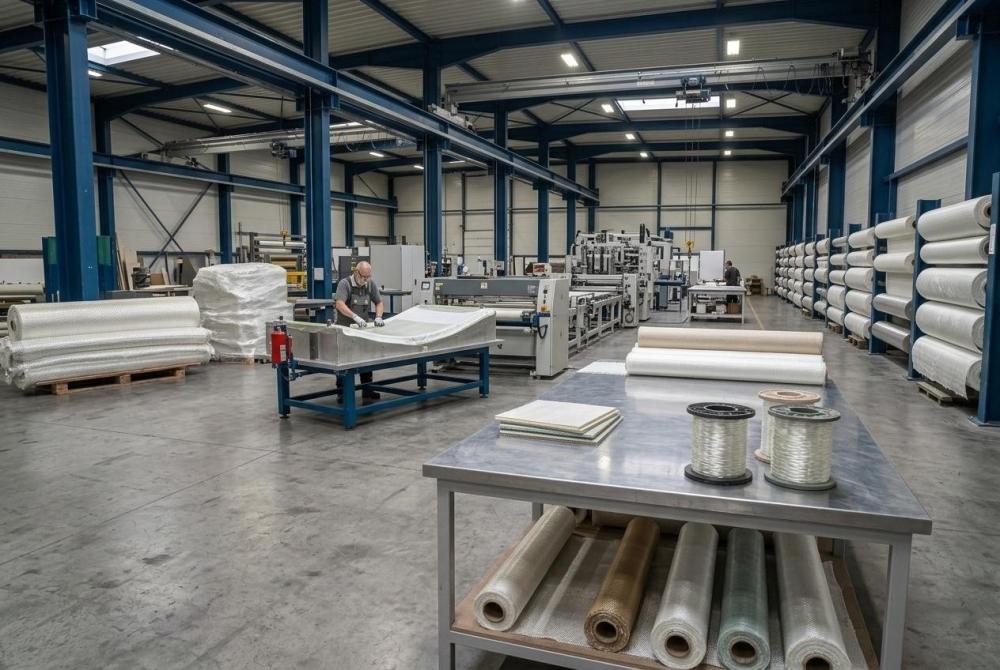
Fiberglass is a lightweight yet flexible material, making it a popular choice for a wide range of applications, from planters and fountains to decorative elements and products for commercial projects. But what exactly is fiberglass? And what makes it suitable for these uses? Understanding fiberglass's composition and how to use it helps in selecting the right product for each project, especially when specific shapes, dimensions, or colors are required. This material also allows for the manufacture of diverse products tailored to specific usage and design requirements.
In this article, we learn about what fiberglass is, its components, its most important properties, its uses, and how it is manufactured and shaped.
What is fiberglass?
It is a composite material consisting mainly of fine glass fibers combined with a resinous material to form a product that combines durability, lightness, and flexibility in shaping.
This material can be manufactured in various shapes and thicknesses depending on its intended use. It is used in many applications, such as:
● Agricultural basins , planting pots and plants.
● Various pieces for home and garden .
● Parts of boats and vehicles.
● Products and structures that require custom shapes.
What are the basic components of fiberglass?
The components of fiberglass vary depending on the type of product and the manufacturing method, but the basic components usually include:
● Glass fibers: provide the basic reinforcement for the material and contribute to increasing its strength and stability.
● Resin: Acts as a binding agent that surrounds the fibers and gives the product its final shape after hardening.
● Additives: These may be used to improve certain properties or to control the speed of hardening or the method of processing.
● Dyes or colors: Added when needed to obtain a specific color or appearance for the final product.
● Finishing layers: These can be used to obtain a finished surface with the desired look and feel.
How is fiberglass manufactured?
The manufacturing process for this material involves several stages, the details of which vary depending on the product's shape, size, and the molding method used. The process typically includes the following stages:
1. Mold preparation: Determines the shape and dimensions of the final product.
2. Laying the fiberglass: The fiber layers are arranged according to the required thickness and design.
3. Adding resin: The fibers are saturated with resin to form the composite material.
4. Forming and processing: The layers are left to set and harden according to the manufacturing method used.
5. Removing the product from the mold: After the solidification is complete, the product is separated from the mold.
6. Finishing: The edges and surfaces are treated, then the required colors or finishing layers are added.
7. Final inspection: The dimensions, surface quality, and conformity of the product to the agreed specifications are verified.
Why is fiberglass considered a practical material in industry and decoration?
The use of fiberglass in industry and decoration is due to a range of properties that give it flexibility in various applications, most notably:
● Relatively lightweight: compared to some traditional materials, which may make products easier to transport and handle.
● Formability: It can be used to implement geometric and curved shapes and custom designs.
● Variety of colors and finishes: Products can be finished with different appearances and colors according to the design.
● The ability to implement special sizes: This is an important feature for projects that require products that fit a specific area.
● Versatility of uses: It can be used in agricultural and decorative products and items for indoor and outdoor spaces.
● The ability to manufacture relatively large or complex products: depending on the design, manufacturing method, and molds used.
For this reason, this material is used in many products that combine functional requirements and aesthetic appearance, with the possibility of customizing the product to suit the nature of the project.
What is the difference between fiberglass and traditional materials?
Fiberglass differs from many traditional materials such as concrete, metals, and wood in that:
● Weight: Fiberglass is relatively lighter than concrete and some metal products, which may make it easier to transport and handle.
● Forming: It can be formed into various curves and geometric shapes, whereas some traditional materials may require more complex manufacturing processes to achieve the same shape.
● Customization: Fiberglass products can be made in different sizes, shapes, colors and finishes.
● Appearance: It can be finished to achieve an appearance that matches the interior or exterior design.
● Usage: Suitable for a wide range of applications, but the choice of material should be based on the technical requirements of each project.
Therefore, there is no single material that suits all uses; rather, the choice depends on the nature of the product and the conditions under which it will be used.
When choosing fiberglass for a project that requires an unconventional shape or size, it is important to deal with a factory capable of producing the product according to the requirements of use, rather than being satisfied with ready-made products.
The art formation factory It is the best fiberglass factory in Saudi Arabia , which offers customized solutions in terms of design, sizes, colors and finishes according to the needs of each project.
Where is fiberglass used in everyday life?
Fiberglass is used in numerous products and applications, some of which we use directly or see in our surroundings. Some of its most prominent uses include:
● Agricultural basins and plant pots in various shapes and sizes.
● Fountains, wall waterfalls , separate and other elements used in landscaping.
● Decorative pieces and aesthetic elements designed for homes and commercial establishments.
● Some parts for boats, vehicles and industrial applications.
● Outdoor space components and equipment that require custom designs and sizes.
● Products for commercial projects that require shapes or dimensions not available in ready-made products.
The material's flexibility allows for the manufacture of products that vary in shape and size according to their use, making them suitable when standard sizes are not sufficient.
How is fiberglass used in decoration and outdoor spaces?
The use of fiberglass in decoration and outdoor spaces depends on the nature of the desired element and its function. It can be used to design a wide range of products suitable for outdoor spaces, including:
● Custom-made planting beds to suit building entrances, walkways, and gardens.
● Implementation of fountains and waterfalls in geometric or curved shapes according to the design.
● Creating decorative pieces with colors and finishes that are compatible with the identity of the place.
● Implementing products with special dimensions for restaurants, hotels, complexes and commercial projects.
When the goal is to coordinate an outdoor space with pieces specifically designed for the location, custom manufacturing allows for greater flexibility in determining shape, size, color, and finish.
The Artistic Forming Factory allows the production of customized fiberglass products according to the required sizes and designs, with the possibility of choosing the color and finish to suit the nature of the project and its overall appearance. It is the best specialized fiberglass factory .
How does fiberglass differ depending on the type of resin used?
The product's performance does not depend solely on the fiberglass; the type of resin used also affects the properties of the final material. Some of the most common types of resins used in the manufacture of composite products include:
● Polyester resin: Commonly used in many fiberglass products, it is easy to process and has a wide variety of applications.
● Vinyl ester resin: It offers different properties in terms of resistance to certain chemical agents and moisture, and is used in applications that require higher performance under certain conditions.
● Epoxy resin: It has good mechanical properties and adhesion ability, and is used in specific applications according to product requirements.
The final choice depends on the intended use, the surrounding environment, the required specifications, and the manufacturing method. Therefore, the factory's experience in selecting materials, their proportions, and processing methods plays a crucial role in the quality of the final product.
The Artistic Forming Factory relies on specialized manufacturing expertise to produce a variety of fiberglass products according to project requirements, paying attention to details including design, size, and final finish.
What factors affect the quality of fiberglass products?
The quality of fiberglass products does not depend solely on the type of material, but is affected by a range of other factors, including:
● Fiberglass quality: The quality of the fibers and their degree of regularity affect the properties of the final product and its ability to withstand use.
● Type of resin: The resin must be chosen in accordance with the nature of the product and the environment in which it will be used, whether indoors or outdoors.
● Fiber-to-resin ratio: The ratios used in the composition of the product affect its mechanical properties and the quality of the layers.
● Manufacturing method: The accuracy of mold preparation, material distribution, processing method, and layer handling all affect the final result.
● Product thickness: The thickness must be determined according to the size of the product, the nature of the use, and the expected loads.
● Finishing quality: The final finish affects appearance and protection, especially for products exposed to external factors.
● Usage conditions: The requirements for a product that will be used indoors differ from those for a product exposed to sun, humidity, and temperature changes for extended periods.
● Design and mold: Accurate design and the right mold help to achieve consistent dimensions and shape and reduce defects during manufacturing.
For this reason, it is not enough to look at the external appearance of the product when assessing quality; rather, attention should be paid to the materials used, the method of manufacture, and the extent to which the product is compatible with the purpose for which it was designed.
The art form factory combines made-to-order manufacturing with attention to product details, so that sizes, design, and finishing can be determined according to the nature of the use.
What is the lifespan of fiberglass products?
There is no single lifespan that applies to all fiberglass products, as the expected lifespan varies depending on:
● Product type.
● Quality of materials and manufacturing.
● Place of use.
● The extent of its exposure to sunlight, humidity, chemicals, or mechanical loads.
When manufacturing custom fiberglass products, the art form factory takes care to link the product specifications to the intended use, from the selection of design and dimensions to the finishing details.
Can fiberglass be recycled?
Fiberglass can be recycled, but methods for handling fiberglass waste vary depending on its composition, the type of resin used, and the condition of the material. Some methods that can be used to handle fiberglass waste include:
● Reuse some parts or pieces of products instead of disposing of them, if their condition allows it.
● Mechanical recycling to obtain a material that can be used in other applications, depending on its properties.
● Reusing fiberglass in other applications.
Is fiberglass an environmentally friendly option?
Its environmental assessment is based on the entire product lifecycle, from raw material manufacturing to end-of-life use and disposal. Some aspects to consider include:
● Service life: The product's durability and long service life can help reduce the need for frequent replacement.
● Weight reduction: Some fiberglass products are lighter than alternatives made from other materials, which may reduce transportation requirements in some applications.
● Custom manufacturing: Manufacturing products to the required dimensions helps reduce waste resulting from alterations or using products unsuitable for the site.
How to choose high-quality fiberglass products?
Choosing good fiberglass products requires looking at more than just the external appearance. To select the ideal products, focus on the following points:
● First, define the use, as defining the function helps to determine the required specifications.
● Check the quality of the finish. The surface should be as uniform as possible, without any obvious defects that affect the appearance or use.
● Ask about the materials used to assess their suitability for the nature of the product.
● Check the dimensions and thickness, especially in large products or those that will be subjected to certain loads or usage conditions.
● Pay attention to the structural details; the design must be appropriate for the dimensions of the product and how it is used.
● Choose the appropriate finish for the location, especially since the requirements of a product located in an indoor space differ from the requirements of a product exposed to sun, humidity and weather conditions.
● Ask about the factory's experience. Reviewing examples of previous work helps to form a clearer picture of the level of manufacturing and the ability to implement the required design.
The Artistic Forming Factory offers custom product manufacturing services, with the possibility of executing the design in the required sizes, shapes, colors, and finishes.
His expertise also includes a variety of products such as agricultural basins, fountains, waterfalls and decorative elements, enabling projects to obtain solutions tailored to the nature of each space.
Frequently asked questions about fiberglass
What is fiberglass used for?
It is used in many applications, including agricultural basins, fountains and waterfalls, decorative pieces, as well as products for homes and commercial projects.
Is fiberglass strong?
Yes, fiberglass can provide good mechanical properties that make it strong when the right materials are chosen and it is manufactured in the right way.
Is fiberglass suitable for outdoor use?
Yes, fiberglass types and products can be used in outdoor spaces, but the materials and finishes must be chosen to suit exposure to sunlight, humidity, temperature changes and the nature of the use.
Can fiberglass be manufactured to size?
Yes, many fiberglass products can be manufactured to the required sizes and designs, making them suitable for projects that require sizes or shapes not available in ready-made products.
Can the color of fiberglass products be changed?
Yes, fiberglass products can be made in different colors and finishes depending on the type of product and the required manufacturing and finishing method.
Is fiberglass better than concrete?
There is no best material for all uses, but fiberglass may be appropriate when lightweight, easy to shape, and customization are priorities.
Are fiberglass products difficult to repair?
No, they can be repaired using appropriate techniques and materials. The repair method depends on the type of damage, its location, the size of the product, and its composition.
How do I maintain fiberglass products?
It is recommended to clean the product with materials appropriate to its nature, avoid using materials that may damage the finish, inspect it periodically, and treat any damage or cracking early, taking into account the product's usage instructions.
Where can custom fiberglass products be manufactured in Saudi Arabia?
The Artistic Forming Factory offers customized manufacturing services for a range of fiberglass products, with the possibility of specifying product details according to project needs.
Conclusion
Fiberglass remains a practical and versatile option when the material, design and manufacturing are chosen to suit the nature of the project.
If you are looking for custom fiberglass products with sizes, designs and finishes to suit your needs, you can contact the Artistic Forming Factory to learn about the available solutions and implement your order according to its specifications.